martes, 27 de febrero de 2018

VERB + GERUND/INFINITIVE


VERB  + GERUND/INFINITIVE

El gerundio y el infinitivo son formas de los verbos que actúan como nombres. El gerundio se forma con “-ing” (walkingeating, etc.). Como hemos visto en la lección sobre los verbos, el infinitivo se forma con la preposición “to” (to walkto eat, etc.).

Grammatical Rules (Reglas gramaticales)

1. Cuando un verbo sigue a otro verbo, siempre necesitamos usar el infinitivo o el gerundio. Normalmente usamos el infinitivo después de algunos verbos y el gerundio después de otros. También hay verbos con los que podemos usar el gerundio o el infinitivo.
Ejemplos:
 I can’t afford to buy a new car.(No puedo permitirme comprar un coche nuevo.)
 He began to doubt himself. / He began doubting himself.(Comenzó a dudar de sí mismo.)
 They decided to move to Australia in May.(Decidieron mudarse a Australia en Mayo.)
enjoy listening to music.(Disfruto escuchando música.)
 She hates studying. / She hates to study.(Odia estudiar.)
 You love dancing. / You love to dance.(Te encanta bailar.)
 He needed to leave class early because he had an appointment.(Tenía que salir de la clase pronto porque tenía una cita.)
 She can’t tolerate complaining.(No puede tolerar quejas.)
 tried learning English. / I tried to learn English.(He intentado aprender inglés.)
 My mother could retire, but she keeps working.(Mi madre podría jubilarse, pero sigue trabajando.)
2. Podemos usar el gerundio o el infinitivo como objeto, sujeto o complemento de una frase, pero en general, es mucho más común usar el gerundio como sujeto.
Ejemplos:
Objeto:
 I like cooking. / I like to cook.(Me gusta cocinar)
 She continued working. / She continued to work.(Continuó trabajando.)
Sujeto:
 Swimming is good exercise.(Nadar es un buen ejercicio)
 Drinking and driving is dangerous.(Beber y conducir es peligroso.)
Complemento:
 The best thing to do when you are sick is to drink a lot of water.(Lo mejor que puedes hacer cuando estás enfermo es beber mucha agua.)
 My favorite exercise is swimming.(Mi ejercicio favorito es la natación.)
3. Con algunos verbos, cuando usamos el gerundio y el infinitivo, el significado cambia.
forget (olvidar),  mean (significar),  remember (recordar)stop (parar)
Ejemplos:
Gerundio:
 I forgot writing that email.(Me olvidé que escribí ese correo electrónico.)
Infinitivo:
 I forgot to write that email.(Me olvidé de escribir el correo electrónico.)
Gerundio:
 Stop watching the news.(Deja de ver las noticias)
Infinitivo:
 Stop to watch the news.(Para, para ver las noticias.)
4. Se usa el infinitivo después de adjetivos.
disappointed (decepcionado)glad (contento),  happy (feliz)pleased (satisfecho),  
relieved (aliviado),  sad (triste),  surprised (sorprendido)
Ejemplos:
 I’m glad to see you.(Me alegro de verte.)
 She was surprised to find the door unlocked.(Se sorprendió al encontrar la puerta abierta.)
5. Después de preposiciones solo podemos usar el gerundio.
about (sobre),  against (contra),  at (a),  after (después de)before (antes),  by (por),  on (en),  without (sin)
Ejemplos:
 He’s good at listening.(Escucha bien.)
 I always read before going to bed.(Siempre leo antes de acostarme.)
 You can’t leave without saying goodbye.(No puedes salir sin despedirte.)
6. Se usa el gerundio después de unos nombres.
advantage/disadvantage of (la ventaja de, la desventaja de),  danger of (el peligro de),  experience in (experiencia en),  interested in (interesado en),  opportunity of (oportunidad de),  reason for (la razón de),  problem with (el problema con)
Ejemplos:
 What is the advantage of waiting?(¿Cuál es la ventaja de esperar?)
 I am interested in taking English classes.(Estoy interesado en tomar clases de inglés.)
 His problem finding a new job was his lack of experience.(Su problema para encontrar un nuevo empleo era su falta de experiencia.)
7. Se usa el gerundio después de unas expresiones o verbos frasales.
 to look forward to (tener ganas de),  to be worth (valer),  can’t help (no poder evitar),  don’t mind (no importarse),  feel like (no apetecerse)
Ejemplos:
 We’re really looking forward to seeing you.(Tenemos muchas ganas de verte.)
 That movie is not worth seeing.(No vale la pena ver esa película.)
 I can’t help falling in love.(No puedo evitar enamorarme.)

GRAMMAR RELATIVE CLAUSES

GRAMMAR RELATIVE CLAUSES

Utilizamos los pronombres relativos para referirnos a un sustantivo (una persona o una cosa) mencionado antes y al que queremos agregar más información o modificar. Los pronombres relativos pueden referirse a algo o alguien en singular o plural. Algunos pronombres relativos se pueden usar sólo con personas, otros sólo con cosas y algunos con ambos. A continuación, tienes una lista de los pronombres relativos.
     
PronombrePersonaCosa
  that 
que
xx
  which 
que / cual
x
  who 
que / quién
x
  whom 
que / a quien
x
  whose 
cuyo
xx

Grammatical Rules (Reglas gramaticales)

El pronombre relativo se encuentra en lugar de un sustantivo. Este sustantivo suele aparecer anteriormente en la oración.

That

“That” es el pronombre relativo más utilizado en el inglés hablado, ya que se puede utilizar tanto con personas como con cosas. Se utiliza para sustituir “which”“who” o “whom” en cláusulas que definen el sustantivo.
Ejemplos:
This is the book that won the Pulitzer prize last year.(Este es el libro que ganó el Permio Pulizer el año pasado.)
This is the restaurant that received the excellent reviews in the newspaper.(Este es el restaurante que recibió excelentes críticas en el periódico.)


Which


“Which” sólo se puede utilizar con las cosas.
Ejemplos:
My new job, which I only started last week, is already very stressful.(Mi nuevo trabajo, que acabo de empezar la semana pasada, ya es muy estresante.)
The house which we lived in when we were children burnt down last week.(La casa en la que vivíamos cuando éramos niños se quemó la semana pasada.)

Who

Solo se puede utilizar “who” con personas.
Ejemplos:
My sister, who just moved in with me, is looking for a job.(Mi hermana, que se acaba de mudar conmigo, está buscando trabajo.)
I never met someone who didn’t like music.(Nunca he conocido a alguien que no le guste la música.)


When and where and why

Estos adverbios relativos a veces se utilizan en lugar de un pronombre relativo para hacer la frase más fácil de entender. Estos adverbios se refieren a expresiones de tiempo, lugares o motivos.
Ejemplos:
The university where I teach is an excellent school.(La universidad donde enseño es una escuela excelente.)
Can you tell me when is the best time to call?(¿Puedes decirme cuando es la mejor hora para llamar?)Nota: Puede omitirse el pronombre relativo cuando es el objeto de la frase.
Ejemplos:
The exam that I took this morning won’t be corrected and returned until next week.(El examen que hice esta mañana no se corregirá ni se devolverá hasta la semana que viene.)
The woman who I’m dating is a teacher.(La mujer con quien estoy saliendo es profesora.)


Relative Clauses (Cláusulas relativas)

Se utilizan los pronombres relativos para unir dos o más cláusulas, formando así lo que llamamos “cláusulas relativas”. Hay dos tipos de cláusulas relativas: las que añaden información adicional y aquellas que modifican (o definen) el sujeto de la oración.

Non-defining Relative Clauses

Estas cláusulas agregan información adicional. Se utilizan comas para separar la cláusula relativa del resto de la oración. No se puede utilizar “that” en lugar de “which” o “who” en este tipo de cláusula.
Ejemplos:
My friend Tony, who is an excellent writer, is helping me with my English paper.(Mi amigo Tony, quien es un escritor excelente, está ayudándome con mi redacción de inglés.)
The report, which my boss asked me to write last week, still isn’t finished.(El informe, que mi jefe me pidió que escribiera la semana pasada, todavía no está terminado.)

Defining Relative Clauses

Estas cláusulas definen el sustantivo e identifican a qué cosa o persona nos referimos. No se usan comas con este tipo de cláusula.
Ejemplos:
I wrote the report that you asked for.(Escribí el informe que me pidió.)
She never met the man who saved her father’s life.(Nunca conoció al hombre que salvó la vida de su padre.)Nota: El significado de la frase cambia dependiendo de qué tipo de cláusula relativa se utiliza.Ejemplos:
The employees who worked long hours completed their projects on time.(Los empleados que trabajaban largas horas terminaron sus proyectos a tiempo.) 
Nota: Sólo los que trabajaron muchas horas terminaron los proyectos a tiempo.
The employees, who worked long hours, completed their projects on time.(Los empleados, que trabajaron muchas horas, terminaron sus proyectos a tiempo.) Nota: Todos los empleados terminaron los proyectos a tiempo.


martes, 30 de enero de 2018


MODALS OF DEDUCTION: MUST, CAN´T, MIGHT, MAY, COULD

Usamos modal verbos para decir qué tan seguros estamos de algo.
Must
Usamos must cuando estamos seguros de que algo es cierto porque hay pruebas.
He must live near here because he comes to work on foot. We don’t know where he lives but we’re sure it’s not far away.

Debe vivir cerca de aquí porque viene a trabajar a pie. No sabemos donde vive, pero estamos seguros de que no está muy lejos.

Come inside and get warm – you must be freezing out there.

Entra y calmate; debes estar helado alli afuera.

You’re a zookeeper? That must be very interesting.
Eres un cuidador de Zoológico? Eso debe ser muy interesante.
Nota: must va seguido de un infinitivo ‘to’.

Might, May, Could

Utilizamos mightmay could para decir que creemos que algo es posible pero no estamos seguros.

Did you hear that? I think there might be a burglar downstairs. She’s not sure there’s a burglar but she thinks it’s possible.
¿Se enteró que? Creo que podría haber un ladrón abajo. No está segura de que haya un ladrón pero cree que es posible.

We’ll try to get there early but we may arrive late if there’s a lot of traffic.
Trataremos de llegar temprano pero podemos llegar tarde si hay mucho tráfico

Don’t put it up there. It could fall off and hit someone.
No lo pongas ahí arriba. Podría caerse y golpear a alguien.
Mightmay could tambien son seguido por in infinitivo ‘to’.

Can’t

Usamos can’t cuando estamos seguros de algo que no es verdad.
 
 It can’t be a burglar. All the doors and windows are locked. He doesn’t know it’s not a burglar but he feels sure it’s not.
No puede ser un ladrón. Todas las puertas y ventanas están bloqueadas. Él no sabe que no es un ladrón, pero está seguro de que no lo es.

       It can’t be far away now. We’ve been driving for hours. Where’s the map?
No puede estar muy lejos ahora. Hemos estado conduciendo durante horas. ¿Dónde está el mapa?

      Really? He has to work on Christmas Day? He can’t feel very happy about that.
De Verdad? Él tiene que trabajar en el día de Navidad? Él no puede sentirse muy feliz por eso.
Can’t seguido de un infinitivo ‘to’.


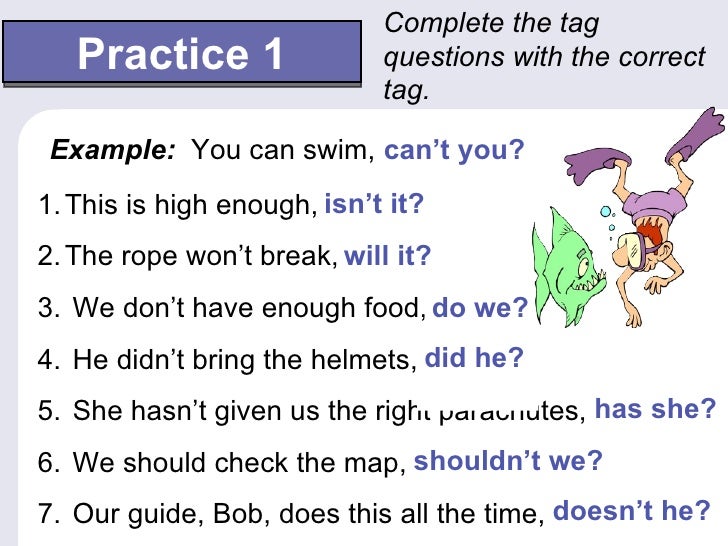
TAG QUETIONS

Los tag questions son pequeñas frases o preguntas que se colocan al final de una oración afirmativa o negativa y que generalmente tienen como objetivo confirmar o negar el contenido de la frase misma. 
TRES REGLAS BASICAS QUE DEBES RECORDAR
1.
Los tag questions utilizan siempre los verbos auxiliares.
2.
Con oraciones afirmativas utilizamos un tag question en NEGATIVO.
3.
Con oraciones negativas utilizamos un tag question en AFIRMATIVO o POSITIVO.


a) ORACIONES  AFIRMATIVAS  CON EL VERBO TO BE EN PRESENT SIMPLE O CONTINUO.
Se utiliza la misma forma del verbo en NEGATIVO: 

  • aren't you?
  • isn't he? 
  • isn't she? 
  • isn't it? 
  • aren't we? 
  • aren't you? 
  • aren't they? 

  1. It's a beautiful day, isn't it? (Es un día hermoso, ¿no?)
  2. Martha is angry, isn't she? (Marta está enojada, ¿verdad?)
  3. You are really tired, aren't you? (Estás muy cansado, ¿no?)
  4. They're very nice people, aren't they? (Son personas muy agradables, ¿no?)
  5. You are coming tomorrow, aren't you? (Vas a venir mañana, ¿verdad?)
  6. Pedro's flying now, isn't he? (Pedro está volando en estos momentos, ¿no?)
UNICAMENTE en este caso en particular, para la primera persona del verbo to be se utiliza aren't I? como equivalente de am I not?:
I'm late, aren't I? (Llego tarde, ¿no?)
I'm arriving late at night, aren't I? (LLegaré tarde por la noche, ¿no?)
b) ORACIONES  NEGATIVAS  CON EL VERBO TO BE EN PRESENT SIMPLE O CONTINUO.
Se utiliza la misma forma del verbo en AFIRMATIVO o POSITIVO: 

  • am I? 
  • are you? 
  • is he? is she? 
  • is it? are we? 
  • are you?
  • are they? 

  1. I'm not late, am I? (No llego tarde, ¿no?)
  2. It isn't a beautiful day, is it? (No es un día hermoso, ¿verdad?)
  3. Martha isn't angry, is she? (Marta no está enojada, ¿no?)
  4. You aren't really tired, are you? (No estás muy cansado, ¿verdad?)
  5. They aren't very nice people, are they? (No son personas muy agradables, ¿no?)
  6. You aren't coming tomorrow, are you? (No vas a venir mañana, ¿no?)
  7. Pedro isn't flying now, is he? (Pedro no está volando en estos momentos, ¿no?)
c) ORACIONES  AFIRMATIVAS  CON EL VERBO TO BE EN PAST SIMPLE O CONTINUO.
Se utiliza la misma forma del verbo en NEGATIVO: 

  • wasn't I? 
  • weren't you? 
  • wasn't he? 
  • wasn't she? 
  • wasn't it? 
  • weren't we? 
  • weren't you? 
  • weren't they? 
It was a beautiful day, wasn't it? (Fue un día hermoso, ¿verdad?)
Martha was angry, wasn't she? (Marta estaba enojada, ¿no?)
You were really tired, weren't you? (Estabas muy cansado, ¿verdad?)
You were studying at 6, weren't you? (Estuviste estudiando a las 6, ¿no?)
He was flying when I phoned, wasn't he? (Estaba volando cuando llamé, ¿no?)

d) ORACIONES  NEGATIVAS  CON EL VERBO TO BE EN PAST SIMPLE O CONTINUO.
Se utiliza la misma forma del verbo en AFIRMATIVO o POSITIVO: 

  • was I? 
  • were you? 
  • was he? 
  • was she? 
  • was it? 
  • were we? 
  • were you? 
  • were they? 

  1. It wasn't a beautiful day, was it? (No fue un día hermoso, ¿no?)
  2. Martha wasn't angry, was she? (Marta no estaba enojada, ¿no?)
  3. You weren't really tired, were you? (No estabas muy cansado, ¿verdad?)
  4. You weren't studying at 6, were you? (No estuviste estudiando a las 6, ¿no?)
  5. He wasn't flying when I phoned, was he? (No estaba volando cuando llamé, ¿no?)
e) ORACIONES AFIRMATIVAS CON OTROS VERBOS COMUNES O DEFECTIVOS.
Teniendo siempre en cuenta el TIEMPO VERBAL, se utiliza el auxiliar en NEGATIVO que corresponde a la persona de la oración: 
didn't she? 
hasn't she? 
won't she? 
shouldn't she? 
can't she? 
couldn't she? 
aren't there?

  1. You went to Costa Rica in 1990, didn't you? (Fuiste a Costa Rica en 1990, ¿no?)
  2. Elena has traveled a lot, hasn't she? (Elena ha viajado mucho, ¿no?)
  3. Ann will be here soon, won't she? (Ana estará pronto aquí, ¿verdad?)
  4. Tom should pass his exam, shouldn't he? (Tom debería aprobar su examen, ¿no?)
  5. You can play the violin, can't you? (Sabes tocar el violín, ¿no?)
  6. He could find a job, couldn't he? (Pudo encontrar trabajo, ¿verdad?) 
  7. There are twelve animals in the Chinese horoscope, aren't there?  (Hay doce animales en el zodíaco chino, ¿verdad?)
Resultado de imagen para tag question

Verbs  whit stative and dynamic uses Stative verbs Los verbos estativos tienen una duración indefinida. ellos denotan estados en lu...